When Reading T.S. ELiot
Sehnaoui's recent work is primarily inspired by the writings of T.S.
Eliot. As Eliot's poems articulate the disillusionment of a younger
post-World-War-I generation, with the values and conventions-both
literary and social-of the Victorian era, Sehnaoui's work
articulates and emotes sardonic and elegiac vignettes of modern
life; as well as human consciousness and its aridities. Sehnaoui
accomplishes this with a complex intelligence, creating a unique
language and vocabulary of observation. Sehnaoui's work conveys the
same irony as Eliot's writing. As many, she shares the idea that by
understanding Eliot's writing, creating under his influence, in
addition to responding to her immediate environment and
circumstances, one understands and can create work that depicts an
understanding of oneself.
Similair to Eliot, the artist gets rid of personal elaboration and
creates work that is based on the most important elemental aspects
of the human condition—the spirit. Eliot believed that the artist
must be impersonal in the creative exercise of the craft. Qualities
of serenity and religious humility became paramount in his work. He
accomplished this in moving verse, a transcendental sense of time.
Sehnaoui accomplishes the same by creating spare, clean, focused
compositions; often made with materials that are patterned, grid
like, acerbic and rarefied. Sometimes using archetypal-like markings
or text to present the drama and poetry in her work. Within her
compositions she uses the imagery of urban life in a context of
poetic intensity. As Eliot, the artist develops pronounced views on
literary, religious, and social subjects. The starkness and
repetitive quality of her work share the Eliot conception of the
sterility of modern society in contrast with societies of the past.
Similar to Eliot's work, Sehnaoui's work is often meditative, grave,
sorrowful, dry, experienced and harsh. Some of the work has a
conversational tone of everyday life to enter into the discussion of
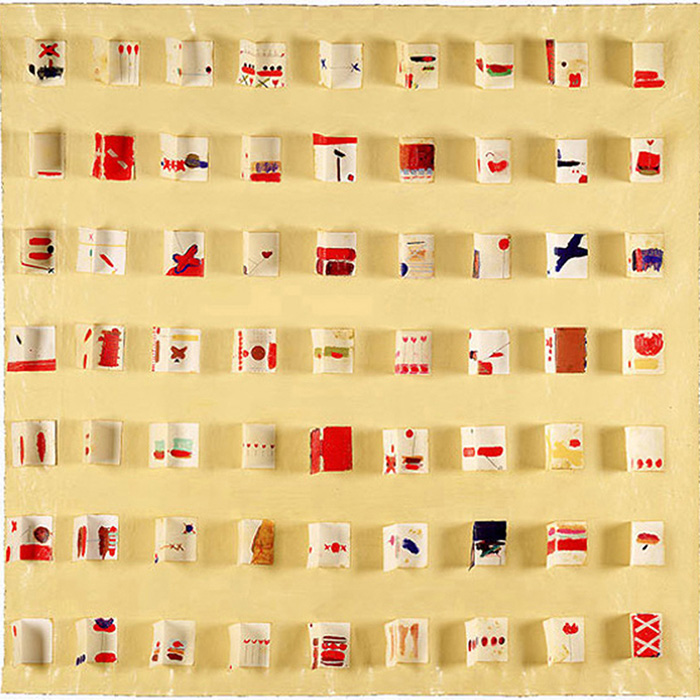
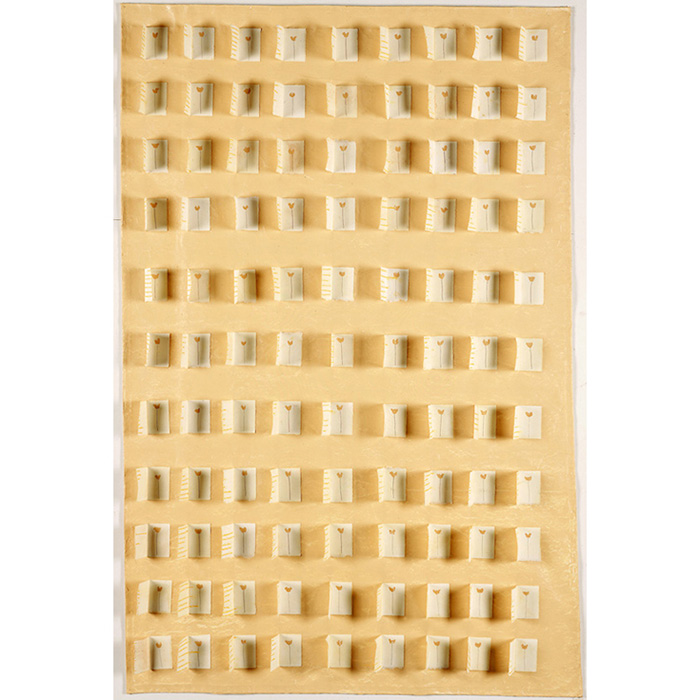
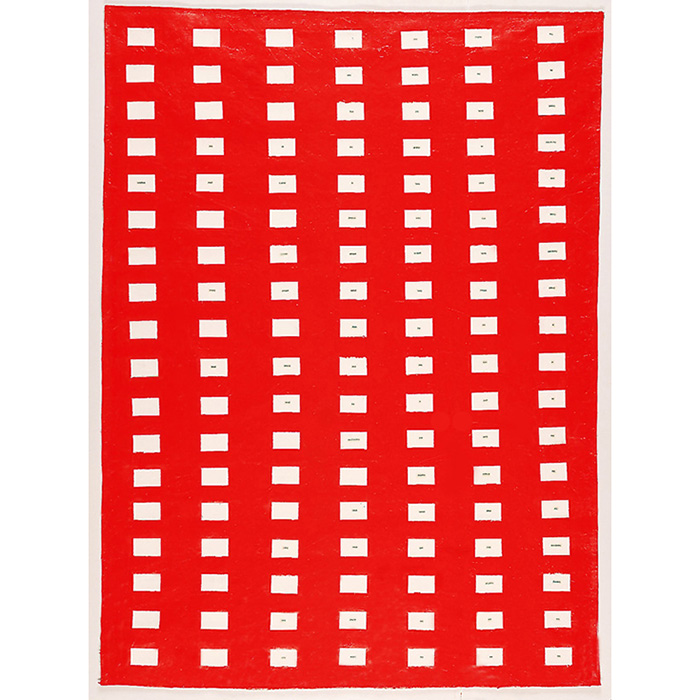
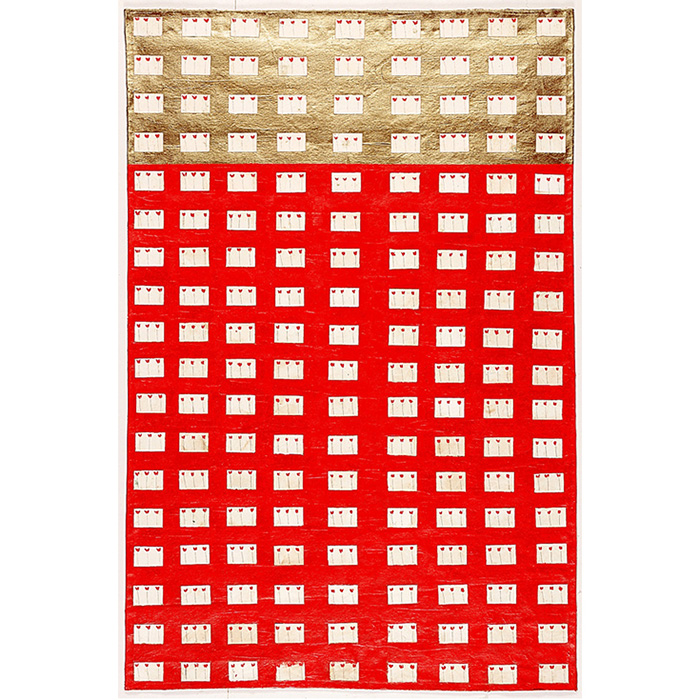
the deepest subjects. In the works of, "Reading T.S. Eliot II and
III," each booklet that makes up one integral part of a massive grid
like whole, invites the viewer to peep within its contents. Within
each booklet the viewer finds a curious, precious, space. Within
these spaces are images, symbols and archetypes, conveying or
inciting thoughts and feelings about the human condition.
Throughout the artist's artistic journeys she has responded
creatively to her environments, particularly that in her war-torn
homeland, Lebanon. Some of her imagery is influenced by both the
horrors and injustices of war and also the inheritable rights and
spirits of man to be both good and bad and how the prevailing
majority of spirits of man are good. The beauty of her homeland and
of nature inspires her, as well as beauty that provoke spirituality
in man that can be unconditional and transcendent. The texts within
these intimate spaces have color, space, and texture. They convey
something even more whole… meaning and emotion.
Many of the artist works also display her interpretation and
response to society, and in some respect also have a religious
overtone, not in a dogmatic way, but in philosophical one. In the
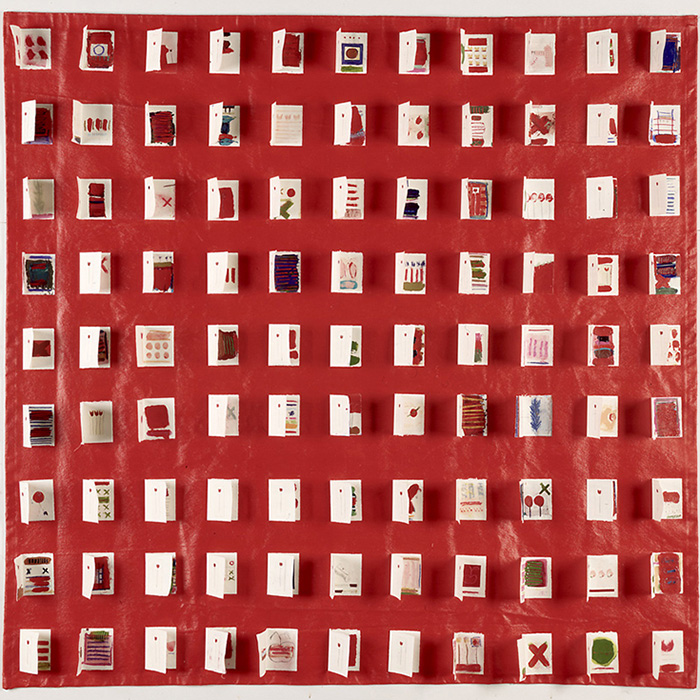
work, "Legal Violence," the artist rebels the legal family laws in
Lebanon, which are still under the power of religious courts,
whether Christian or Muslim, that are unfair to women with regards
to custody of their children. The work is vividly red, bloodlike,
alarming. There is a repetitive line drawn in the center of each of
numerous squares, except for one in the right area of the canvas
where you see what seems like a figure image within one of the paper
squares attached to the canvas. The single figured square,
surrounded by numerous other squares, emotes a sense of futility.
The work pleads for the particular human condition illustrated
within to change.
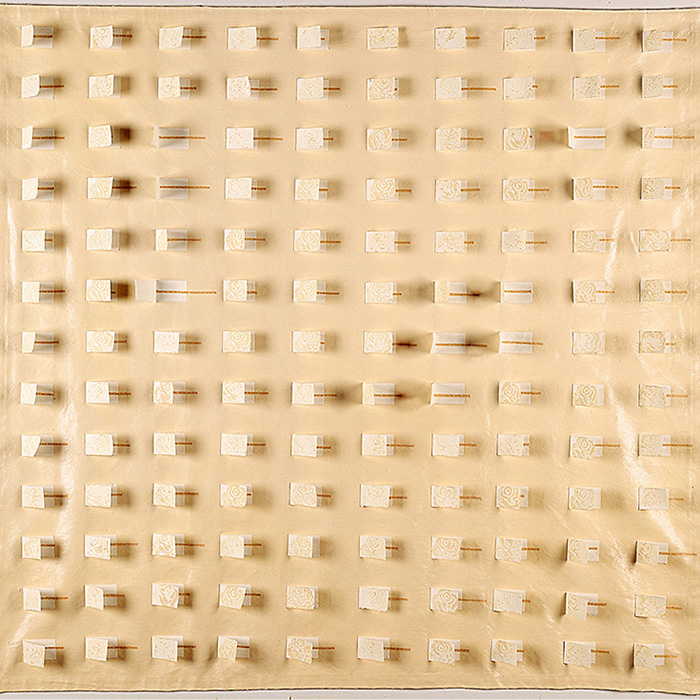
"Reading T.S. Eliot," "Burnt Norton and T. S. Eliot," and "The
Hollow Man" are works that also provoke commentary on the state of
man and his condition, their repetitive starkness, emulate the
module stanza quality of Eliot's work, the clarity reflects the
aridity and sterility of modern life, contrasting the existential
romantic with the higher order of purity of form and spirituality.
The universal mythic theme of death as a voyage, where one will be
miraculously saved, the Christian mythology of walking on water, all
suggest that we are somewhat lost in life and hopeful that in death
we willll find salvation, peace, and spirituality.
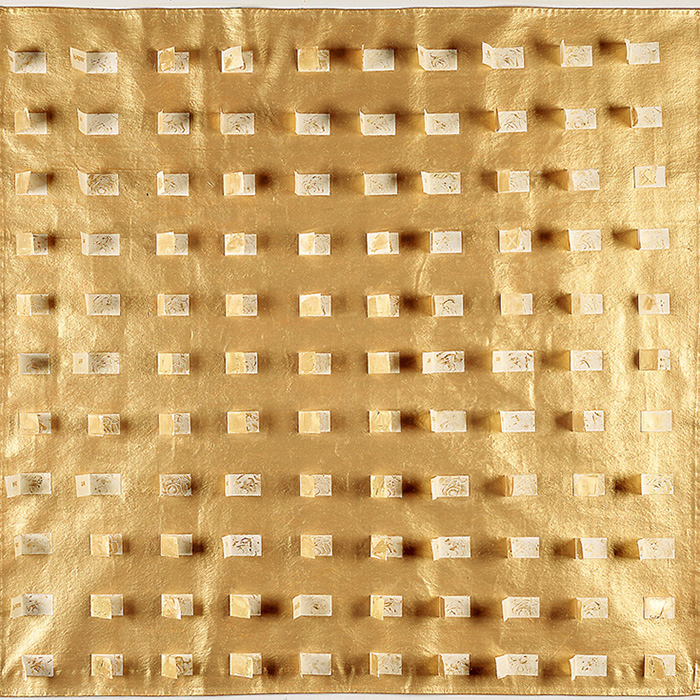
Works such as, "Death by Water," inspired by the poem of the same
name, share a similar train of thought: we need to measure life and
look at it more in the pure sense of the word, beyond the physical
vitality of youth in life, in order to experience a better quality
of life in living and in death. In this work the artist has a square
canvas, painted a yellowish gold. The repetition of attached
booklets of paper, of uniform size, give a feeling of "current under
sea…" The rhythmic patterns that these papers make are like, Eliot's
Phelbas, rising and falling, passing the stages of his age and youth
as in the poem. The artist here appears to provoke the viewer to
experience life, to observe and contemplate the true meaning of
existence that is beyond the vitality and physicality of life. There
is a higher order of things… a spirituality of life that one should
observe, absorb and feel. If one does not, life is somewhat
meaningless. The lack of spirituality in effect lends us to be
soulless.
Denise A. Bibro
Denise Bibro Fine Art
Chelsea, New York City
April 16, 2000